

Photo by Lindsay Kennedy – TALL XIII
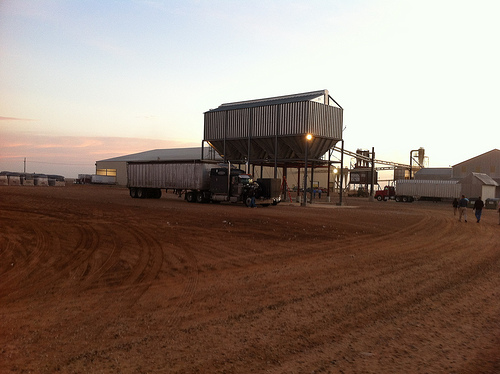
First stop was the Lubbock Cotton Growers Co-op Gin. This co-op gin was established in 1939 and destroyed in a fire. In 2009 they rebuilt a state-of-the-art high capacity gin that gins an average of 70,000 bales per year. We watched the trucks come in and unload the modules (17 tons of raw cotton).
Then the process of removing moisture, seeds, and trash begins. A 500 lb. clean bale is produced and given a bar code for producer identification. This is where a sample is pulled – matching bar code attached – to be sent to the classing office. Each bale is sold individually. The cotton seeds that were removed are used in cattle feed.
I had never been in a cotton field so our next stop at the Heinrich’s cotton field intrigued me. Mr. Heinrich wanted to show us his drip irrigation and the difference it had made in his production. It was truly an abundant field of cotton. Drip irrigation conserves water by delivering it directly to the cotton plant underground preventing water-loss through evaporation. Strip lines are buried in the rows to deliver the water. An irrigation pump attaches to lateral pipe that delivers water to the drip emission lines. So the plant is the direct recipient of the water.

Photo by Lindsay Kennedy – TALL XIII
Before I entered my profession in fashion merchandising – before I sat across the table in Egypt negotiating prices of manufactured combed cotton tee shirts – I should have visited the Fiber and Biopolymer Research Institute. This lab is the only installation of its kind in the US. The research of Dr. Dean Ethridge is critical – looking at the molecular structure of cotton – breaking down the raw material – knowing full well that the fiber’s properties determine its value. Individual fibers are measured and tested – over 100,000 samples a year. They have their own machines to clean – remove moisture – separate and count the fibers – blend if required – wind to spindles or draw and twist onto spools. They are always looking at length, strength, and fineness. It certainly gives new meaning to those 500 count sheets.
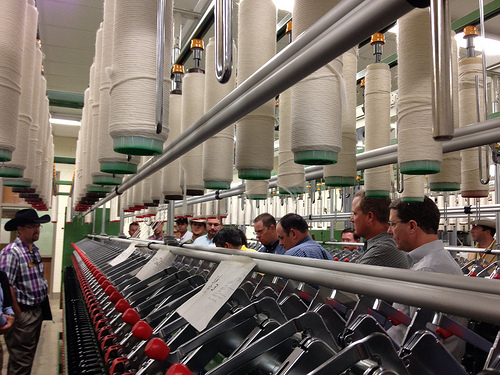
Photo by Lindsay Kennedy – TALL XIII
My Dad was a rice farmer – cattle rancher. So our trip to the Museum Of Agriculture was in some ways a walk down memory lane. It also makes you smile to look at some of the implements deemed “antiques” and know that they are still being used on some farms today – not retired or considered an antiquity. But it was great to see that Alton Brazell took it upon himself to be one of the first ag advocates – to collect the tractors, plows, horse-drawn equipment, grain binders, hay rakes, household utensils, and farm tools – to tell the story of American agriculture.
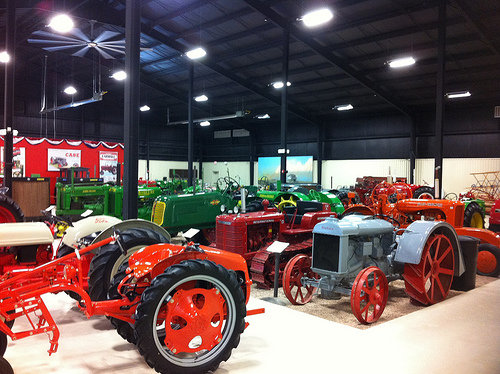
Photo by Lindsay Kennedy – TALL XIII
Mike Gilbert, V.P. with Bayer CropScience spoke to us. He spoke of strength in diversity. Bayer is involved in pharmaceutical (human and animal health care) and plant care. They spend about 8 billion in research. Competition is intense and it costs about 50 million to get a trait on the market. Then it has to make money. The science includes genetically enhanced seeds that don’t require spraying for weeds – the resistance is genetically engineered into the seed. The same science applies to plant disease. In cotton product has been developed that doesn’t wrinkle and wicks. Fiber is being bio-engineered to take dye without having to be treated with chemical – no toxic discharge – lower energy. Of course, they face the raging European challenge – the seeds are not safe. But these bio-engineered seeds maximize production with less acreage and water – they feed the hungry. So hungry countries like India, Africa, and China embrace the technology. It will continue to be an educational process that we will need more of such technology to expand our production to feed the future with less land for production and less water.
Every part of our tour – every speaker at some point in his or her presentation spoke about water. ALL aspects of our future are about water. Mr. McCain made me very uneasy. He said the right things but he also left me feeling that as an ag producer I need to know more about my water board and the decisions that someone else is making for me. I don’t even know who is on my board and how they were appointed – elected – by whom? So in listening to Mr. McCain, I am not sure that that particular board is in partnership with their own ag community. It is difficult to strike a balance – supply vs. demand – ag vs. urban – fact vs. emotion – drought vs. flooding. They forecast our population to increase from 25.4 million to 46.3 million by 2060. The pressure is on to produce food with less water – to protect our water supplies and the environment. The Ground Water Districts are an attempt to plan – 10 year plans are required with a review every 5 years. In this district they are enforcing production rates – metering wells with pumping reported on line. And the water usage has to be “fair” to all – farmers – urbanites – oil and gas – electricity production. Regulation seems a daunting task. It is emotional but necessary for good stewardship to extend the life of our aquifers and maintain the viability of our towns – the future of our children – and their children.
Dr. Jim Bordovsky’s tour at the Halfway Texas A&M AgriLife Research Center really finished connecting all the dots of cotton farming. We actually got to see the cotton stripper moving down the rows harvesting the cotton – the cotton loaded into the transporters to be taken to the module compaction unit –the module then loaded onto trucks rigged out with a “crawler undercarriage” that can pull the modules onto the truck and unload the module at the gin. It really gave me the total picture.
The Spandet Dairy was our next stop with the owner llona Schilderink as our tour guide. This facility milks about 3000 head. We saw the pivot that holds 100 cows at a time for the milking – the hutches for the newborn calves that are bottle fed 3 times a day – the massive grain bins where all the feed is brought in and mixed for the daily feeding – the lagoons for cleaning and recycling water – the loading docks for the trucks to receive and transport the milk. The operation is well planned and efficient – not to mention massive.
We were treated to a lovely dinner at the Spandet Dairy. Mr. Rick Kellison spoke on water conservation and sustainability – again re-enforcing how precious our water supply – the fragile Ogallala Aquifer and the fact that it does not re-charge easily – and how we must be diligent to conserve.
Leave A Comment